
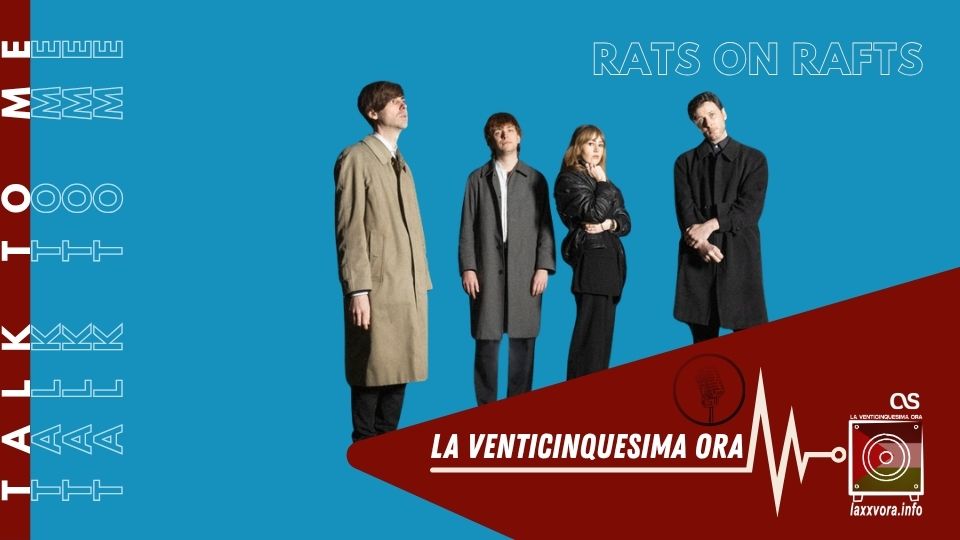
- Band: Rats on Rafts
- Titolo: Deep Below
- Etichetta: Fire Records
- Genere/Stile: Post-Punk, Coldwave, Dream Pop, Minimal Wave
- Paese: Rotterdam, Olanda
- Uscita: 7 febbraio 2025
Abbiamo fortemente voluto parlare con i Rats on Rafts, folgorati lo scorso anno dal loro ultimo album, “Deep Below” e dal recente singolo “Painting roses“.
I loro suoni aprono uno spazio sotterraneo, denso, costruito con strati di pressione e ombre che si muovono come materia viva. Le canzoni respirano in una camera profonda, dove la città si intreccia alla memoria e l’identità prende forma attraverso vibrazioni, scarti, frammenti.
Rotterdam entra in questo spazio come un personaggio. Una presenza che cambia volto, si ricostruisce, si allontana e ritorna; una città che vive in uno stato di trasformazione continua e che spinge chi la abita a muoversi, a cercare nuove direzioni, a rinegoziare il proprio posto. In questo dialogo, tra ciò che si dissolve e ciò che resta, prese forma “Deep Below”: un disco che cerca la temperatura delle cose, la loro densità, la loro ombra.
I Rats on Rafts lavorano per accumulo e sottrazione, per intuizioni improvvise e per stratificazioni lente. Cercano un suono inevitabile, un suono che sembra già esistere e che loro liberano. Le loro canzoni diventano architetture: pressioni, aperture, corridoi che si allungano, stanze che si restringono. Dentro questa costruzione si apre una sincerità che arriva senza forzature, una forma di sollievo, una voce che si avvicina invece di imporsi.
“Deep Below” nasce da un incontro, da una residenza, da un brano che ha aperto una porta e da un altro che l’ha attraversata. Nasce da un momento in cui tutto è venuto fuori di colpo, senza filtri. Nasce da una scelta radicale: nove sfumature di grigio o nero, una coerenza che diventa necessità.
INTERVISTA
“Deep Below” sembra emergere da una pressione sotterranea, quasi fisica. Qual è stato il punto di partenza emotivo o narrativo del disco?
Durante il periodo del COVID siamo stati invitati a scrivere e registrare un brano per il 35° anniversario del locale Ekko, a Utrecht. Abbiamo chiesto all’artista olandese Palmbomen di lavorare con noi. In quei giorni sono nate moltissime idee: la sua etica del lavoro era davvero ispirante. Abbiamo scelto “Cashmere Carey” per la compilation e tenuto da parte i brani che sentivamo più fertili.
Uno di questi, “Once Upon a Dream“, è diventato la base di “Deep Below“: più lento, pieno di synth, più sognante e più oscuro di tutto ciò che avevamo fatto prima. Volevamo continuare su quella strada, ma né noi né Kai avevamo il tempo.
Avevamo già molti brani quasi pronti, così abbiamo prenotato una settimana al Katzwijm Studio per trovare gli ultimi pezzi del puzzle. Abbiamo provato in modo quasi maniacale, registrando tutto su un quattro piste. Tornati nel nostro spazio, abbiamo assemblato rapidamente le parti di un brano che spiccava: “Japanese Medicine“. Un giorno mi sono seduto per registrare delle idee vocali e tutto è uscito di colpo. Una forma di sollievo. Ho lasciato intatto quasi tutto.
“Once Upon a Dream” e “Japanese Medicine” hanno definito l’atmosfera. Liricamente era tutto più introspettivo del solito. Abbiamo lasciato andare gli altri brani e continuato a scrivere in questa nuova direzione. È stato naturale.
Il disco è nato rapidamente, con l’idea che ogni brano dovesse essere una sfumatura diversa di grigio o nero. Alla fine “Once Upon a Dream” non trovava più il suo posto ed è rimasto fuori, anche se gli vogliamo ancora bene.
Rotterdam è sempre stata centrale nella vostra identità, ma in questo disco sembra quasi un personaggio. Come interagisce oggi la città con la vostra musica?
Avendo vissuto qui tutta la vita, e lo stesso vale per Arnoud, la città è sempre stata un personaggio nelle nostre vite. Cambia continuamente, e noi cambiamo con lei.
È un luogo in movimento costante, e questo mi ispira a muovermi, a evolvermi.
Il nostro studio è ai margini della città, vicino all’aeroporto, in un edificio un po’ cupo degli anni ’60. Porta con sé una certa solitudine che diventa molto confortante per lavorare. È un grande contrasto con il centro.
Osservo ancora tutto, ma faccio più fatica a capire cosa sto guardando. Cosa offre questo posto? Perché una città operaia che accoglieva pochissimi visitatori è diventata così popolare? A volte mi sento distante. Io cambio, la città cambia, e il rapporto si trasforma.
In Japanese Medicine c’è un equilibrio delicato tra guarigione e disorientamento. Cosa rappresenta per te questa “medicina”?
La “medicina” diventa un simbolo per affrontare personaggi perduti e giovinezze perdute. Quando pensi alle relazioni, alle amicizie, al tuo io passato, soprattutto quello adolescenziale, quelle figure sembrano dissolversi. Cresci, scopri che non sei immortale, fai scelte, vivi una vita diversa.
Quando ricordiamo, tendiamo a romanticizzare ciò che ci manca, o ciò che crediamo di aver perso. I miei ricordi nascono dalle sensazioni di certi eventi trasformati in storie, che col tempo diventano riassunti, modi per fare pace con il passato.
Molti brani sembrano costruiti come architetture: strati, pressioni, aperture improvvise. Da dove nasce di solito un brano dei Rats on Rafts?
Ogni brano ha la sua storia, ma tutto parte sempre dalla musica. Molte idee nascono improvvisando insieme, suonando finché non troviamo qualcosa di fertile.
Cerchiamo sempre un suono che scorra in modo naturale. A volte cambiamo strumenti per accendere la creatività. “All These Things“, ad esempio, è nata così: Arnoud al basso, Natasha alla chitarra, Mathijs al synth e io alla batteria. Nel giro di pochi minuti c’erano già le parti principali.
Le vostre canzoni spesso ritraggono mondi di solitudine, ma nell’ascoltatore evocano un senso di comunità. È una dualità che esplorateconsapevolmente?
Cerchiamo sempre di creare un nostro piccolo universo sonoro. Viviamo davvero nel nostro mondo. “Deep Below” è stato particolarmente facile da scrivere perché la musica era personale e il mood dei brani molto confortante. Sembrava onesto.
Parte del disco riguarda l’accettazione di cose difficili: guardarsi allo specchio e accogliere ciò che vedi. La musica triste offre spesso un ascolto più attento.
Spero che il disco dia la sensazione di ascoltare chi lo incontra.
Dopo più di dieci anni insieme, come senti che è cambiata l’identità dei Rats on Rafts? Cosa avete lasciato andare o ritrovato?
È un viaggio costante, uno sviluppo continuo. Ogni album è un mondo a sé, un documento di come ci sentiamo in quel momento. Con “Excerpts From Chapter 3” volevamo un collage psichedelico che ti portasse da un mondo all’altro.
Con “Deep Below” abbiamo scelto l’opposto: nove sfumature diverse ma coese, un ritorno alla musica che ci ha formati da adolescenti. Viviamo tempi cupi, diversi dagli anni ’70 e ’80, con somiglianze che rendono il futuro incerto.
Guardando avanti: quali sono i vostri piani? State già lavorando a nuova musica?
Stiamo scrivendo nuovi brani, registrando demo, lasciando alla mente spazio libero.
“Deep Below” ha aperto una stanza in cui c’è ancora territorio da esplorare. Spero avremo tempo e momenti ispirati per continuare su quella strada o per imboccare un’altra direzione che si aprirà lungo il percorso. “Deep Below” costruisce un paesaggio che pulsa sotto la superficie, racconta città che cambiano e identità che cambiano con loro, solitudini che diventano comunità, ricordi che si trasformano in storie per essere accolti.
I Rats on Rafts creano mondi che sembrano distanti e che finiscono per assomigliare ai nostri. La loro musica si avvicina con una delicatezza inattesa, come una stanza che ti accoglie senza chiedere nulla.
Q&A IN ENGLISH (ORIGINAL VERSION)
Deep Below seems to emerge from an almost physical, subterranean pressure. What was the emotional or narrative starting point for the record?
During the COVID period we we’re invited to write and record a song at a venue in Utrecht called Ekko. It would be part of their 35th anniversary LP. For the residency we asked a Dutch artist called Palmbomen to work with us. During these few days we came up with loads of ideas, it was really great to work with him, his work ethic was very inspiring. we chose ‘Cashmere Carey’ for the LP and kept the songs/ideas we felt had more to offer in the long term. One of the songs called ‘Once upon a dream’ became the blueprint for the music of Deep Below. It was slower, synth heavy and dreamier and darker than everything we had ever done before. We really wanted to continue but both us and Kai/Palmbomen simply didn’t have the time. Meanwhile we had a lot of songs practically ready for recording when’s we decided to book a week at Katzwijm studio to find the last pieces of the puzzle. Basically we manically practiced, sketched for a week, recording everything onto a 4 track cassette recording. When we got back to our own practice place and started going through the material we quickly assembled the parts of one song that stuck out: ‘Japanese Medicine’ and one day I sat down to record some vocal ideas and everything just came out. A form of relief. I barely changed anything. It was one of those weird moments when everything fell into place, it was hard to say where it all was coming from, but definitely a reflective moment. ‘Once Upon A Dream’ and ‘Japanese Medicine’ set the mood along with some other parts that had. Lyrically it seems moe inward than usual. We dropped all the other songs and continued to write in this new found direction. It felt so much more natural. As a result the record was written quite quickly after that, with the idea all songs had to be a different shade of grey or black, non of it was allowed to be different. Musically and lyrically. Funny enough when we recorded all the songs we felt ‘Once Upon A Dream’ didn’t fit in anymore and left it off the album, still really like that song though.
Rotterdam has always been central to your identity, but in this album it feels almost like a character. How does the city interact with your music and your writing today?
Having lived here my entire life, and the same goes for our guitarist Arnoud, it’s always been a character in our lives. As we change, the city changes and our relationship towards it as well. Bits and pieces are constantly being rebuilt, redesigned. Like most big cities it’s always on the move and that I think inspires me to keep moving, changing, evolving. Because once you’ve been away for a few weeks your favorite pub has closed and a new one has opened. I’ve always liked the cold looks and character of the city, though that has been warmed up a bit the last 10 years or so. Our studio/practice place is located at the edge of the city, close to the airport, in a somewhat grim building from the 60’s and brings forth a certain kind of isolation/loneliness that can be very comforting to work in. It’s a big contrast with the center of town, I still tend to observe it all, though I find it harder to make out what it is exactly. What am I looking at? What does this place have to offer? I tend to wonder why a working class city that rarely had any visitors has become such a populair place? I do feel a bit alienated from it at times. Have I changed or has the city changed? Or both of us?
In Japanese Medicine there’s a delicate balance between healing and disorientation. What does this “medicine” represent for you: a symbol, a memory, or a way to talk about contemporary rituals?
I guess the medicine part could be seen as a symbol for dealing with lost characters and lost youth. When you think of past relationships, friendships and your former self especially from your teenage years, it feels like those people don’t exist anymore, because you grow up and suddenly you discover your not immortal and have to make choices and your living a somewhat different life as you did years ago. When remembering the past people tend to want to focus on the good parts and leave out the bad ones, over romanticizing the things that they miss, or think they miss. I think my memories are mostly fueled by the feelings of particular events made into a story but as years pass they become much more of a rehearsed story. A summary, a way of coming to terms with your past.
Many tracks feel built like architectures, layers, pressures, sudden openings. How does a Rats on Rafts song usually begin: with an image, a rhythm, an urgency?
Every song has it’s own story, the development of each song can be very different but it always starts with some form of music. Most of the ideas come from improvising together and playing until we find something interesting. We always feel songs need to sound “natural” when writing them. We are constantly looking for ways to ignite our creativity, atmospheric sounds, effects, but again it’s all very different, for example when we wrote “All These Things” we switched instruments for a moment, Arnoud played bass, Natasha guitar, Mathijs synth and I played the drums. Everybody played their part within minutes the song was born. And we switched back to further develop it into a song.
Your songs often seem to sonically portray worlds of solitude, yet I feel they evoke the opposite in the listener: a sense of community and belonging, as if they open a space that contrasts with the narratives imposed from above and instead connects us to our own inner world.
Is this duality something you consciously explore, or does it emerge naturally from your way of writing?
We always set out to create our own little universe of sound that has to be the appeal of the record and we are quite isolated in a way we really do live in our own little world. Deep Below was particularly easy to write because it music felt so personal and I found the mood of each song to be quite comforting. It felt like being honest. Part of it is about coming to terms with things that aren’t really pleasant, like looking in the mirror and accepting what you see instead of fighting it. I’ve always found dark, sad music offers more of a listening ear. In a way I hope the record sounds like it is listening to you instead of the other way around.
After more than ten years together, how do you feel your identity as Rats on Rafts has changed? Is there something you had to let go of, or something you rediscovered?
It’s a constant journey, a constant development, leaving things behind but also rediscovering things. Every album is it’s own world, that documents where we are at in time and how we feel about it.
With “Excerpts From Chapter 3” we set out to make a collage style, psychedelic trip that took you from one world to another, but for “Deep Below” we naturally wanted the complete opposite, 9 shades, different, but very cohesive in mood. Somewhat returning to the music that formed us in our teenage years. Also because a feel we live in dark times again, very different from the 70s and 80s but definitely with some resemblances that makes the future look uncertain.
Looking ahead: what are your future plans? Are you already working on new music, collaborations, or exploring different directions?
We are currently writing new songs, recording demos in between, trying to give our minds a lot of free space to write what comes out naturally. I do feel “Deep Below” has opened a chamber for us in which there is still some undiscovered territory, I hope we will have enough time and inspiring moments to continue down that road, but it could very well be that the road is connected to another one that will lead us somewhere else.


 La Venticinquesima Ora
Lascia un commento