
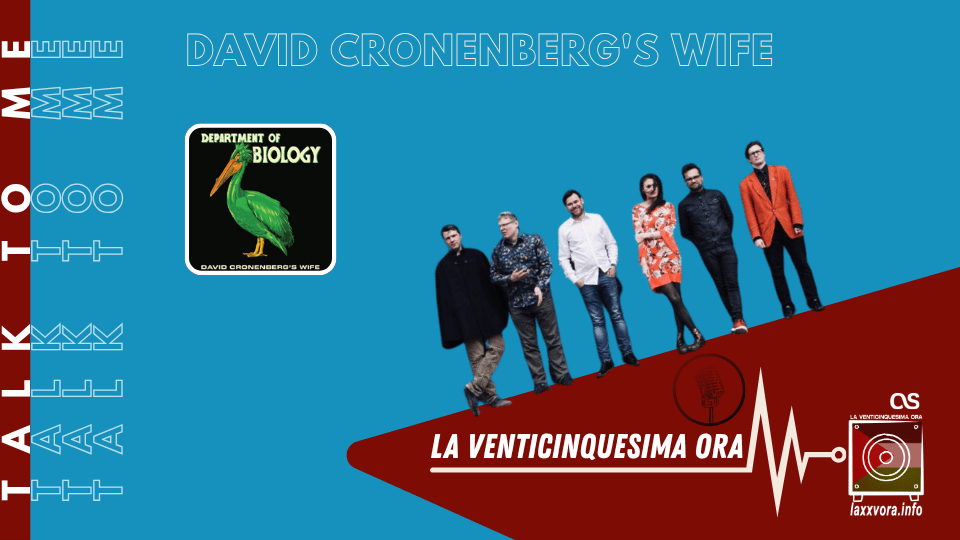
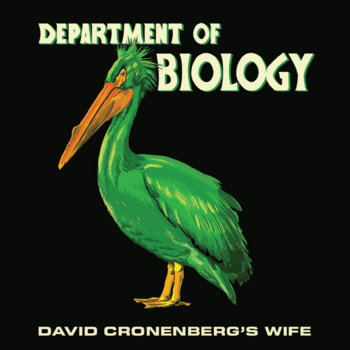
- Band: David Cronemberg’s Wife
- Titolo: Department of Biology
- Etichetta: Blang
- Genere/Stile: Avant Folk, Spoken Word
- Paese: Londra, UK
- Uscita: 1 Maggio 2026
Un disco che respira, un organismo narrativo in continua trasformazione. Nel “Department of Biology” di David Cronenberg’s Wife ancor prima di capire da quale porta si entra ci si ritrova già immersi, come se qualcuno avesse spento la luce un attimo prima che arrivassimo.
È un luogo senza coordinate, dove il tempo si piega e i personaggi respirano come organismi in un laboratorio emotivo. Qui la biologia non è un tema, ma una forza che pulsa sotto la pelle delle canzoni: sesso, morte, mutazioni, desideri.
Tom Mayne parla di dislocazione, di storie bibliche trapiantate nel presente, di noir che sembrano usciti da una New York immaginaria degli anni ’70, di figure che nascono da miti, letteratura russa, ipotesi narrative.
E mentre racconta, evoca Kubrick, Lynch, Cronenberg, Haneke, The Fall, i Velvet Underground: non come influenze, ma come costellazioni interiori.
Il risultato è un album che genera un mondo che ti avvolge e non ti lascia, ne senti il respiro anche da lontano.
Intervista
C’è un forte senso di luogo e atmosfera in tutto il disco. Che mondo stavi cercando di costruire per l’ascoltatore?
L’atmosfera è molto importante, ma per la maggior parte delle canzoni non volevo che ci fosse un particolare senso di luogo o di tempo. Volevo una sensazione di dislocazione, così in “Lot’s Daughters” hai una storia biblica trasportata ai giorni nostri. Eppure “Where Is She?” ha un senso di luogo molto preciso: dai testi puoi intuire che si svolge negli anni ’70 o ’80, probabilmente a New York. Ogni canzone è diversa, ma spero che l’album funzioni come un insieme.
La presenza della “biologia” sembra intrecciata nel tessuto emotivo dell’album. In che modo questa lente biologica influenza il modo in cui scrivi o pensi a queste canzoni?
Quando scrivi una raccolta di canzoni, i temi emergono lentamente. Con l’ultimo album “The Ship” il tema era molto chiaramente la morte. Si potrebbe dire che tutti i personaggi delle canzoni di quell’album muoiono, per questo era sottotitolato “Necrologies”. Con le canzoni di “Department of Biology” il tema principale che ha iniziato a emergere era il sesso. Sesso e morte: gli unici due argomenti che mi interessano! Quindi forse un modo di guardare all’album è che ti trovi nel “dipartimento” dei temi biologici, quasi come se fossimo in un laboratorio e io fossi il professore che conduce gli esperimenti.
Le tue canzoni sono popolate da personaggi vividi, quasi organismi viventi in un ecosistema. Come emergono queste figure per te?
Alcuni hanno esempi reali, “Chekhov’s Bordello”, per esempio, si basa su un lavoro giornalistico dello scrittore russo quando visitò una colonia penale alla fine del XIX secolo. “The Novice” è basata su una poesia del poeta russo Mikhail Lermontov, la trama e il personaggio sono tutti suoi. Per altri, i personaggi nascono da un’idea: “cosa succederebbe se la fidanzata di un uomo alcolizzato sparisse all’improvviso?” “cosa succederebbe se un uomo solo incontrasse una vera sirena?” e così via.
Le scelte sonore, strumenti, texture, dettagli, sembrano profondamente narrative, quasi oggetti di scena in una scena. Come decidi quali suoni portano il peso emotivo o cinematografico di un momento?
Penso che ci sia sicuramente un’influenza del cinema nella musica, non avere solo chitarra/basso/batteria, ma usare suoni ed effetti che evocano un certo umore. Registrare l’ossatura principale delle canzoni con la band non ha richiesto molto, forse un giorno, ma poi sono seguite molte, molte ore di overdub e sessioni di missaggio in cui noi, principalmente io e il nostro produttore Jon Clayton dello studio OneCat, abbiamo aggiunto altri strumenti e provato diversi effetti, facendo centinaia di piccole decisioni che, messe insieme, iniziano a creare la canzone. È fondamentalmente tentativi ed errori. Come diceva Stanley Kubrick: “Non so sempre cosa voglio, ma so cosa non voglio.” Alla fine del processo è spesso questione di istinto, come dall’ottico: “Quale vedi meglio, A o B?”, e la differenza è minima. Devi solo fidarti del tuo sentimento. In totale ci saranno stati circa 18 mix prima delle versioni finali.
“Mermaid’s Tale” sembra sospesa tra mito e biologia, una creatura immaginata e dolorosamente reale. Qual è stata la scintilla dietro questa canzone e come ne hai modellato l’atmosfera?
Be’, il mito della sirena dice che possono trasformarsi in forma umana. Ma il sesso è molto fisico, molto presente, quindi per me è sembrato naturale considerare che, se le sirene esistessero davvero, come avverrebbe il processo di procreazione? Deporrebbero uova o rilascerebbero uova come i pesci, e l’unico modo per fertilizzarle sarebbe attraverso il metodo descritto nella canzone. Poiché la canzone ha molte parole, ho capito che la struttura doveva essere semplice. Quando l’ho suonata per la prima volta (in un ristorante vegano a Edimburgo) ero io con la chitarra che facevo gli accordi completi, La minore e Do. Ma poi ho capito che potevo semplificarla ancora di più, riducendola praticamente a tre note sulla nostra tastiera Casio MT‑68. E quella è diventata la base della canzone, perché aveva bisogno di una qualità molto lenta, cupa, quasi funebre.
“Where Is She” ha la tensione di una scomparsa, quasi una sequenza da film su una persona svanita. Come è nata questa traccia e cosa rappresenta per te questo senso di “assenza”?
Forse un’influenza su questa canzone è “The Twilight Hour” dei The The, dove un uomo aspetta che la sua ragazza chiami. Avevo alcuni accordi al piano che avevano una qualità molto noir, che ha informato l’ambientazione. Poi ho scritto un sacco di testi, ma era troppo lungo. Così li ho tagliati fino a ciò che senti sul disco. Forse avrei dovuto tagliarli ancora di più. Abbiamo passato molto tempo sulle atmosfere di quella canzone. In origine aveva della batteria, e abbiamo sperimentato vari effetti, aggiungendo qualche chitarra qua e là, e poi togliendone un po’, perché non volevamo che diventasse troppo piena. L’equilibrio doveva essere giusto per catturare quel senso di “assenza”. A differenza di molte canzoni dell’album, la voce è asciutta perché sei nella mente dell’uomo e non volevamo creare distanza con il riverbero.
““If You Think About It” sembra la rivelazione silenziosa dell’album: biologica, esistenziale, cinematografica. Cosa cercavi di catturare nel DNA emotivo di questa canzone?”
Ho finito i testi di questa canzone letteralmente un minuto prima di registrarli, scarabocchiandoli su un foglio. Prima di questo, avevo molte linee intelligenti ma non emotivamente coinvolte. Ho fissato la pagina a lungo cercando parole migliori. La risposta è stata aggiungere molte cose della mia vita che hanno un aspetto personale, e poi aggiungere linee che sembrano personali ma non lo sono. La musica è nata da una jam con la band in sala prove, e una volta registrata abbiamo lavorato sul suono. Il mix precedente era molto più asciutto della versione finale, ma quando Adam ha suonato quel delay sulla chitarra in una versione live ho capito che dovevamo metterlo anche sul disco.
Alcune tracce sembrano primi piani, altre campi lunghi. Quanto sei consapevole dell’“inquadratura” quando arrangi o produci una canzone?
Ogni canzone segue la propria logica, quindi non ne sono così consapevole. Tuttavia, il personale è molto importante per me o almeno scrivere in un modo che sembri personale. Uno dei miei cantautori preferiti è Jeffrey Lewis da New York. Ha un modo di racchiudere ciò che sembrano essere i suoi pensieri e sentimenti particolari, espressi in un modo in cui chiunque può identificarsi. Molte delle nostre canzoni non sono così, ma cerco di averne una per album, seguendo i maestri di questo tipo di scrittura, come Leonard Cohen, per esempio.
L’album ha un’identità sonora molto distintiva. Quali influenze musicali ovvie o inaspettate hanno fatto parte della sua genesi?
Non ho davvero band in mente quando registro. Cerchi di rendere la canzone il più unica possibile, pur rendendoti conto che stiamo tutti riciclando ciò che è venuto prima. Nulla può essere davvero nuovo. Ma se la gente ci paragona ai The Fall o ai Velvet Underground ne sono molto, molto felice perché quelle due band sono pura arte, e se posso arrivare a un centesimo di ciò che hanno fatto, posso ritenermi soddisfatto.
Oltre alla musica, ci sono film, libri, opere o riferimenti visivi che hanno plasmato l’umore, il tono o la narrativa dell’album?
Il cinema è molto importante per me. Ci sono molti riferimenti letterari nelle canzoni, ma crescendo i film hanno forse avuto un ruolo ancora più importante: Kubrick, David Lynch e naturalmente David Cronenberg. Non mi piace l’etichetta di “cinema estremo”, ma sono sempre stato attratto dai film che portano l’arte ai suoi limiti, come Michael Haneke o Todd Solondz. O l’atmosfera che Lynch ha creato in “Mulholland Drive” e “Twin Peaks”. Abbiamo cercato di replicare un po’ quella sensazione in “Deliquescence in Saltland” e “Where Is She?”. “120 giorni di Sodoma” di Pasolini è sul mio scaffale, ma non l’ho ancora guardato. Lo sto conservando, insieme a “Raw Power” degli Stooges. È importante conservare certe cose.
“Department of Biology” è un LP dego di essere ascoltato con attenzione, Tom Mayne é una delle penne migliori di questi anni, non riuscirete a stare lontani dalle sue canzoni, una volta che lo incontrerete nel vostro cammino. Ogni personaggio è un esperimento emotivo, un film realista e fantastico allo stesso tempo. Mayne costruisce mondi che non esistono eppure sembrano familiari, popolati da figure che oscillano tra mito, letteratura, cronaca e desiderio. E lo fa con una lucidità rara, con un’attenzione quasi chirurgica al dettaglio, con un immaginario che tiene insieme Kubrick e Lermontov, Lynch e La Bibbia, The Fall e la biologia. È un album che altera la realtà ma per evidenziarne la sua verità più profonda.
RINGRAZIAMENTI
Un ringraziamento speciale a Tom Mayne per il tempo dedicato, la generosità delle sue risposte e la profondità con cui ha aperto il suo processo creativo. La sua disponibilità ha reso possibile un viaggio dentro l’album che va oltre la semplice intervista.
ENGLISH VERSION (Q&A)
There’s a strong sense of place and atmosphere throughout the record. What world were you trying to build for the listener?
Atmosphere is very important, but for the majority of the songs I didn’t want there to be any particular sense of place or time. I wanted a sense of dislocation – so in ‘Lot’s Daughters’ you have a bible story transported to the modern day. Yet ‘Where is She?’ has a very particular sense of place: from the lyrics you can surmise it takes place in the 70s or 80s, probably in New York. Each song is different but hopefully the album comes together as a whole.The presence of “biology” feels woven into the emotional tissue of the album.
How does this biological lens shape the way you write or think about these songs?
When you’re writing a collection of songs themes slowly emerge. With the last album ‘The Ship’ the theme was very much death. You could argue that all of the characters in the songs of that album die – that’s why it was subtitled ‘Necrologies’. With the songs on ‘Department of Biology’ the main theme that started to be apparent was sex. Sex and death – the only two subjects I’m interested in! So perhaps one way of looking at it is that with this album you’re in the ‘department’ of biological themes, almost as if we’re in a laboratory and I’m the professor who is doing the experiments.Your songs are populated by vivid characters, almost like living organisms in an ecosystem.
How do these figures emerge for you?
Some have real life examples – ‘Chekhov’s Bordello’, for example, is based on a journalistic work by the Russian writer when he visited a penal colony at the end of the 19th century. ‘The Novice’ is based on a poem by the Russian poet Mikhail Lermontov – the plot and character are all his. For others, the characters are borne out of an idea: ‘what would happen if an alcoholic man’s girlfriend disappeared suddenly?’ ‘what would happen if a lonely man met a real life mermaid?’ and so on.
Your sound choices, the instruments, textures, and small sonic details, feel deeply narrative, almost like props or gestures in a scene. How do you decide which sounds carry the emotional or cinematic weight of a moment?
I think there is definitely an influence of cinema on the music – not having just straight guitar/drums/bass, but using sounds and effects that conjure up a particular mood. Recording the main skeleton of the songs with the full band didn’t take very long – maybe a day – but then there followed many, many hours of overdubs and mixing sessions where we – primarily me and our producer Jon Clayton from OneCat studio – added other instruments and tried different effects, making hundreds of small decisions which, when taken together, start to create the song. It’s basically trial and error. Like Stanley Kubrick said, “I do not always know what I want, but I do know what I don’t want.” Right at the end of the process it is often instinct – like when you’re at the optician – ‘Which looks better A or B?’, and there’s not much in it. You just have to trust your feeling. There were probably in total about 18 mixes before the final versions.“Mermaid’s Tale” feels suspended between myth and biology, a creature imagined and painfully real.
What was the spark behind this song, and how did you shape its atmosphere?
Well, the myth of the mermaid says that they can change into human form. But sex is very physical, very present, so to me it seemed natural to consider that if mermaids truly did exist, then how would the procreation process occur? They would lay eggs or spawn like fish, and then the only way to fertilise them would be through the method described in the song.
Because the song has a lot of words, I realised that the structure had to be simple. When I first played it (in a vegan restaurant in Edinburgh) it was with me on guitar playing the full chords – A minor and C. But then I realised I could simplify it even further, to basically three notes on our Casio MT-68 keyboard. And that became the basis of the song, as it needed a really slow, gloomy, almost funereal quality to it.“Where Is She” has the tension of a disappearance, almost like a missing‑person sequence in a film.
How did this track come to life, and what does its sense of ‘absence’ represent for you?
Perhaps an influence on this song is the track ‘The Twilight Hour’ by The The, where a man is waiting for his girlfriend to call. I had some chords on the piano which had a real noir-ish quality to them which informed the setting. I then wrote a bunch of lyrics, but it was too long. So, I cut them down to what you hear on the record. Maybe I should’ve cut them down even further. We spent a long time on the atmospherics of that song. It originally had some drums on it, and we played around with various effects, adding some extra guitar here and there, and then taking some of it out, because we didn’t want it to become too cluttered. The balance had to be right to capture that sense of ‘absence’. Unlike a lot of songs of the album, the vocal is dry because you’re in the man’s mind and we didn’t want there to be any distance there through reverb.
“If You Think About It” feels like the album’s quiet revelation — biological, existential, cinematic. What were you trying to capture in this song’s emotional DNA?
I actually finished the lyrics to this song literally one minute before I recorded them, scribbling them down on paper. Prior to this, I had lots of lines which were clever but not emotionally involved. I stared at the page for a long time trying to come up with some better words. The answer was to add a lot of stuff from my own life which have a personal aspect and then to add lines which sound as if they could be personal to me but which are not. The music came out of a jam with the band when we were in the rehearsal studio, and once we recorded it, again, we worked on the sound. The earlier mix was much drier than the final version, but when Adam played the delay sound on the guitar in a live version I knew we had to have that on the record.
Some tracks feel like close-ups, others like wide shots. How conscious are you of “framing” when arranging or producing a song?
Each song follows its own logic, so I’m not that conscious of it. However, the personal is very important to me – or at least writing in a way that seems personal. One of my favourite songwriters is Jeffrey Lewis from New York. He has a way of encapsulating what seems to be his particular thoughts and feelings, all expressed in a way that anyone can relate to. Many of our songs aren’t like that, but I do try and have a song like that on each album – to follow the masters of this type of song, like Leonard Cohen, for instance.
The album has a very distinctive sonic identity. Which musical influences — whether obvious or unexpected, were part of its genesis?
I don’t really have any bands in mind when I record. You try and make the song sound as unique as possible while realising that we’re all just recycling what has come before. Nothing can be truly new. But if people compare us to The Fall or The Velvet Underground I’m very, very glad because those two bands are pure art, and if I can get to a hundredth of what they did I can finish very happily.
Beyond music, were there films, books, artworks or visual references that shaped the mood, tone or narrative of this album?
Cinema is a very important to me. There’s a lot of literature references in the songs, but growing up films perhaps played an even more important role for me: Kubrick, David Lynch, and of course, David Cronenberg. I don’t like the tag ‘extreme’ cinema, but I always was drawn to films that took art to its limits – like Michael Haneke or Todd Solondz. Or the mood that Lynch created in ‘Mulholland Drive’ and ‘Twin Peaks’. We tried to replicate that feeling a little bit in ‘Deliquescence in Saltland’ and ‘Where is She?’ Pasolini’s ‘120 days of Sodom’ is on my shelf, but I still haven’t watched it. I’m saving it, along with The Stooges’ ‘Raw Power’. It’s important to save things.
ACKNOWLEDGMENTS
A special thanks to Tom Mayne for his time, the generosity of his answers, and the depth with which he opened up about his creative process. His availability made possible a journey inside the album that goes way beyond a simple interview.


 La Venticinquesima Ora
Lascia un commento